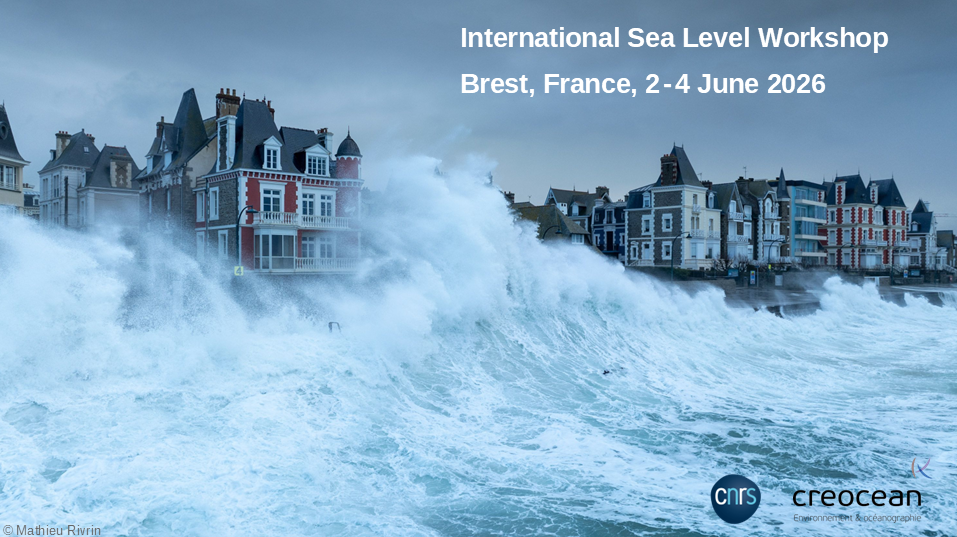
The International Sea Level Workshop aims at discussing sea level changes (past, present and future) at global, regional and coastal scales. Studies in very nearshore areas, related to sea level rise, flooding, coastal erosion, and adaptation strategies are welcomed. Studies considering all possible data sources (in situ observations, remote sensing, aerial photographs, numerical simulations, climate models) are also welcomed.
The workshop aims to share expertise and promote collaborations among actors, particularly between public organizations and private companies.
The workshop will take place at Brest, France, from 2-4 June 2026. We plan to have an in-person meeting only.
Abstract deadline: 15 March 2026
Registration deadline: 15 April 2026
The draft program is available here (updated 07/04/2026).
Context
Planet Earth is globally warming mostly due to human activities. More than 90% of this energy has warmed the global ocean. The remaining has served to warm the atmosphere, the land and to melt both the land ice (ice sheets and glaciers) and floating sea ice. Global mean sea level rise is one of the most direct consequences of the actual global warming. This global rise is caused by ocean warming (known as thermosteric sea level) and the imports of fresh water from continents (i.e., ice sheets mass loss, mountain glaciers melting and land water change). Satellite altimetry data have revolutionized our knowledge on sea level changes because of the near global coverage. It has been shown that the global mean sea level trend experiences large regional variability. In addition to ocean warming and land ice imports, regional sea level changes are also sensitive to salinity changes, ocean circulation, atmospheric pressure, wind stress and air sea heat fluxes. These large-scale regional sea level changes may interact with the land throughout the coastal areas.
The coastal areas are exposed to a large range of coastal hazards. Sea level rise will lead to flooding of the low-elevation coastal zones, coastal erosion and salt intrusion in nearshore ecosystems. In the future, climate extreme events are expected to increase. At the same time, the coastal areas are more densely populated. The number of people living in the low-elevation coastal zones could double between 2000 and 2060. Adaptation strategies are needed to face future evolutions. For example, nature-based solutions may help to face sea level rise and coastal hazards.
Objectives of the workshop
The International Sea Level Workshop aims at discussing past, present and future sea level changes and its contributors, at global and regional/coastal scale, from all possible data sources (in situ observations, remote sensing, aerial photographs, numerical simulations). The workshop also aims to present and discuss possible solutions and strategies of adaptation. The workshop will focus on all the processes that contribute to sea level from subannual (high frequency processes such as tide, internal tide, storm surges, waves, infragravity waves, meteotsunamis, seiches, tsunamis…) to multi decadal changes (such as ocean heat content and freshwater content changes, freshwater imports from land, ocean circulation/transport, etc…).
Call for abstracts
Abstracts have to be submitted online before 15 March 2026. The final agenda will be available early April 2026.
Abstract guidelines
Abstracts should not exceed 300 words, excluding the title, authors and their designations.
Organisation
The workshop is organized by CNRS and CREOCEAN. The workshop will benefit from supports of CNES through the Ocean Surface Topography Science Team (OSTST).
Organizing Committee
William Llovel, LOPS, CNRS (william.llovel@ifremer.fr)
Lucia Pineau-Guillou, CREOCEAN (lucia.pineau-guillou@creocean.fr)
 Loading...